We've arrived safely in India, and have spent the past few days in the Bangalore area. We stayed at the Fireflies Ashram, a place that is dedicated to being an interface between the sacred and the secular in India. They are interfaith, but primarily Hindu. Much of our time there was spent getting over jet-lag, though we visited the Mysore palace and a 13th century Hindu temple in some remote village, in addition to a cow ashram and a lecture at United Theological College in Bangalore.
I don't know hoy I am going to assemble all these experiences and pieces of information together. So much has happened in only three days, and there's so much to reflect upon: poverty, the expanding middle class, different cultural understandings, awkward bathrooms....the list goes on!
So I'm going to try and update when I can, but the internet isn't very fast, the computers are slow, and we get limited time at internet cafes. Plus, writing e-mails to Ben is a priority. :-)
Until next time....
Wednesday, January 09, 2008


Sunday, December 30, 2007
My Sunday
Sundays are always busy days for pastors. I knew this going into ministry, but I wasn't prepared for the full extent of how much of a drain on my introverted system Sundays are. Especially on the Sundays I preach, I'm ready for a nap by 1 in the afternoon (otherwise, I'm ready for a nap by 2 or 3). But there's always more to do - youth group, or a mailing or things to plan - and then there's the hour-long car ride home that somehow morphs into an hour-thirty affair with traffic back-ups on Rt. 22 or Rt. 1 (depending on the route I take). I come home, and the last thing I want to do is do reading for class or write a reflection paper...and the first thing I want to do is either sleep or eat a lot of really-bad-for-you junk food.
Although I am dead tired (from preaching and from watching my beloved team manage an undefeated season), tonight when I go home, I'll be going home to a loving husband who will be taking me out to dinner and to see "A Christmas Carol" at the Shakespeare Theatre. I'm hoping for a more enjoyable time than when I went to see "Henry VI" (Ben liked it. I didn't.) And then tomorrow I'll get to sleep in before starting the day with preparations for India, readings for India, and the dreaded CPE application.
Well, it's just about time for youth group, so that's it for now...
(On a completely unrelated note, I just discovered that I have dried cookie dough all throughout my engagement ring. Nice.)
Although I am dead tired (from preaching and from watching my beloved team manage an undefeated season), tonight when I go home, I'll be going home to a loving husband who will be taking me out to dinner and to see "A Christmas Carol" at the Shakespeare Theatre. I'm hoping for a more enjoyable time than when I went to see "Henry VI" (Ben liked it. I didn't.) And then tomorrow I'll get to sleep in before starting the day with preparations for India, readings for India, and the dreaded CPE application.
Well, it's just about time for youth group, so that's it for now...
(On a completely unrelated note, I just discovered that I have dried cookie dough all throughout my engagement ring. Nice.)
Saturday, December 29, 2007
ARGH
I'll be one of the first to tell you that grades don't really matter in the long run. What matters is the work you put into the class and your understanding of the material, yada, yada yada...except when I checked on my grades from this past semester and got royally angry about my preaching grade because I fail to see how I got that grade (unless I totally bombed my preaching self-evaluation, which I don't think I did). I think I'm going to cool off a bit before I e-mail him, asking how the heck he assigned the grade he did.
Maybe grades matter to me more than I thought they did...even grades from useless classes we have to take.
Maybe grades matter to me more than I thought they did...even grades from useless classes we have to take.
Trials of a Student #1
Student Health Insurance doesn't cover anything. You would think that since students are prone to traveling (because when else in your life are you going to have the opportunity to do it), student health insurance would cover things like...medicine to prevent you from getting malaria (always a good thing). Instead, students are expected to shell out $167 for 30 tablets, a cost we are expected to pay out of our pockets (in addition to the $1800 for the trip to India, about $100 for all the immunizations and other medications, and not to mention the fees for the visa and the international student ID card and the like). Of course, $167 is nothing compared to the cost of contracting malaria...and it is about $60 cheaper than filling the prescription at CVS or Rite Aid, and $20 cheaper than Target or Walmart.
Yet it is a luxury that I can even purchase these pills in the first place to prevent me from getting malaria when so many people - especially children - die from the disease every single year. Every day, even. Most people living in these places where malaria is prevalent don't even have basic protection - like a mosquito net treated with chemicals to kill the mosquitoes that are spreading the disease. I'm lucky enough to be able to afford this while thousands more suffer.
So instead of griping about the lousy student health insurance that doesn't cover prescriptions, I should be thankful that a drug like this is available for me to purchase and that I have the resources to be able to afford it. I just wish these trips weren't so darn expensive! With all these fees, there'll be no money left for me to shop with...
Yet it is a luxury that I can even purchase these pills in the first place to prevent me from getting malaria when so many people - especially children - die from the disease every single year. Every day, even. Most people living in these places where malaria is prevalent don't even have basic protection - like a mosquito net treated with chemicals to kill the mosquitoes that are spreading the disease. I'm lucky enough to be able to afford this while thousands more suffer.
So instead of griping about the lousy student health insurance that doesn't cover prescriptions, I should be thankful that a drug like this is available for me to purchase and that I have the resources to be able to afford it. I just wish these trips weren't so darn expensive! With all these fees, there'll be no money left for me to shop with...
Thursday, December 27, 2007
It was Christmas?
 Thinking about this past week, Christmas seemed a little surreal. No snow (not the first time), no heavy-duty apartment decoration except for our little tree (no time and no money), and no time off made the holiday fly by. By December 26th my To-Do list filled a page - and none of them small tasks either! Chief among them are the "pastor's article" for the church newsletter, a CPE application to
 In light of the content of the story, I've been thinking a lot about how Christmas is just a messy thing. It's just not this pristine, sanitary story that our culture (and carols like "Away in a Manger") has made it into. Shamed, disgraced, and homeless Mary and Joseph and Jesus in a smelly, stinking barn with no family or friends to witness the birth, save for a few shepherds (as Luke tells it).
And in light of all the work and business and everything...maybe a messier Christmas is just the thing.
Wednesday, December 26, 2007
Be the Church!
Once again, I have fallen behind on my blogging (both in writing and in keeping up with posts others have written). This time, it was due to a delightful vacation up in Massachusetts, time with family and friends, completing a class project, and then coming back to NJ with Christmastime right around the corner. Now, the guests are gone (though my in-laws aren't tough guests at all!), and it's just me and Ben again, although I have my fair share of things to do before I leave for India. (By the way, it really stinks that student health insurance doesn't cover the cost of Malaria medicine...)
There is something I would love to share with you all - the website for our class project! The catch is this - it's our first draft for our real church plant proposal. By clicking the link, you will be privy to our first attempt at concretizing a year's worth of conversations and dreams, and if you keep coming back, you'll be able to follow our journey as this church plant proposal emerges and takes life - and be engaged with it every step of the way! So please, visit http://bechurchne.org and be sure to give me feedback (on the content, the form, the design of the website) so that we can improve our ideas going forward and so that you, too, can be a part of our process!
Merry Christmas!
There is something I would love to share with you all - the website for our class project! The catch is this - it's our first draft for our real church plant proposal. By clicking the link, you will be privy to our first attempt at concretizing a year's worth of conversations and dreams, and if you keep coming back, you'll be able to follow our journey as this church plant proposal emerges and takes life - and be engaged with it every step of the way! So please, visit http://bechurchne.org and be sure to give me feedback (on the content, the form, the design of the website) so that we can improve our ideas going forward and so that you, too, can be a part of our process!
Merry Christmas!
Wednesday, December 12, 2007
New England = Home
It's nice to be back in New England. For one thing, there's snow on the ground (and there was snow as we were coming up; it wasn't all from the recent storm!). We drove up on Sunday on a (somewhat) impulse decision. We had been planning a Sunday drive northward, but when we looked at the weather, it was supposed to snow/sleet/wintry mix about the time we'd be driving through Hartford and Worcester. No good. However, when we checked again on Sunday, the storm had been pushed to later (around six), and so we decided to make a go of it. We drove up, and encountered no bad weather at all!
Just because I'm home doesn't mean there is nothing to do! We still have to finish our class project for church planting, which will be a website (currently in the works. Check out our intro page at http://bechurchne.org). I have several preparations for India in the works: getting tevas, packing, malaria medicine, etc. There are Christmas gifts to make (I've decided I'm going to try and hand-make all my gifts; we'll see how that turns out...at the very least, I want my gifts to come from sources that don't oppress or exploit people and/or the environment). And, there's the all-important task of resting and relaxing.
Right now, I'm in a process of discerning what I want to do with this blog. I haven't kept it up nearly as much now that I've started journaling more (something that has proved rather fruitful after nearly two weeks). Perhaps I'll move it elsewhere...perhaps I'll discipline myself to cull thoughts and insights from my journal (that are shareable) once or twice each week. I'm feeling the need to go deeper with this than I am at right now. We'll see.
On a purely superficial sports note, I am sooooooo ready for next week's Patriot's v. Jets game. I hope the Pats run up the score...
Just because I'm home doesn't mean there is nothing to do! We still have to finish our class project for church planting, which will be a website (currently in the works. Check out our intro page at http://bechurchne.org). I have several preparations for India in the works: getting tevas, packing, malaria medicine, etc. There are Christmas gifts to make (I've decided I'm going to try and hand-make all my gifts; we'll see how that turns out...at the very least, I want my gifts to come from sources that don't oppress or exploit people and/or the environment). And, there's the all-important task of resting and relaxing.
Right now, I'm in a process of discerning what I want to do with this blog. I haven't kept it up nearly as much now that I've started journaling more (something that has proved rather fruitful after nearly two weeks). Perhaps I'll move it elsewhere...perhaps I'll discipline myself to cull thoughts and insights from my journal (that are shareable) once or twice each week. I'm feeling the need to go deeper with this than I am at right now. We'll see.
On a purely superficial sports note, I am sooooooo ready for next week's Patriot's v. Jets game. I hope the Pats run up the score...
Sunday, November 25, 2007
I'm alive and older
A couple days ago I turned 25 - a quarter of a century years old. I don't feel that much older, but I suppose I now definitively fall into that mid-twenties age range that just sounds old. A grad student, married, in her mid-twenties. Old.
Not really. :-)
I spent the Thanksgiving Holiday with my in-laws, made a vow not to buy anything save for the necessities (like food) on Black Friday, unsuccessfully shopped for shoes on Saturday, and went to a wonderful wedding up at Dartmouth on Saturday afternoon. Then, we drove back to New Jersey, and got in a bit after midnight.
This morning, I went to visit Vision Community Church in Warwick, NY. They are a church plant in the Methodist Tradition, as their parent church is a church in the New York Conference. I have to admit, it was nice to be able to sit back and worship without being responsible for something in the service. Don and Pam Heatley, the pastors of this church, had come in and spoke to our church planting class a couple weeks ago, and I was impressed with what they had to say about their church. Visiting, I was also impressed -- they have hospitality down like no one else's business! Igniting Ministries or whatever branch of the church deals with welcoming people should take a tip or five from Vision. I was well-greeted and introduced to other people in the congregation. They serve breakfast before their services (bagels and coffee, and they also had apple pie and pumpkin pie and other pastry things), and people can bring their food into the services with them. The sermon was great, worship tended towards contemporary (with the music blended and communion at the end).
More later...if I get motivated enough (I need to be more disciplined about my blogging).
Not really. :-)
I spent the Thanksgiving Holiday with my in-laws, made a vow not to buy anything save for the necessities (like food) on Black Friday, unsuccessfully shopped for shoes on Saturday, and went to a wonderful wedding up at Dartmouth on Saturday afternoon. Then, we drove back to New Jersey, and got in a bit after midnight.
This morning, I went to visit Vision Community Church in Warwick, NY. They are a church plant in the Methodist Tradition, as their parent church is a church in the New York Conference. I have to admit, it was nice to be able to sit back and worship without being responsible for something in the service. Don and Pam Heatley, the pastors of this church, had come in and spoke to our church planting class a couple weeks ago, and I was impressed with what they had to say about their church. Visiting, I was also impressed -- they have hospitality down like no one else's business! Igniting Ministries or whatever branch of the church deals with welcoming people should take a tip or five from Vision. I was well-greeted and introduced to other people in the congregation. They serve breakfast before their services (bagels and coffee, and they also had apple pie and pumpkin pie and other pastry things), and people can bring their food into the services with them. The sermon was great, worship tended towards contemporary (with the music blended and communion at the end).
More later...if I get motivated enough (I need to be more disciplined about my blogging).
Monday, November 12, 2007
Meh.
I'm finding it abnormally difficult to concentrate on this chilly, November morning. Perhaps because it's Monday and normally my day off. Perhaps because I can't seem to get the study warm enough for my fingers. Perhaps because I'm being forced to write a sermon for class and I'm just not into it. Perhaps because I can easily think of five better things to do with my time:
1) Start working on designing a website for our new church. We'd have profiles of us, stuff about our process, videos, etc...
2) Pick out the wedding photos I want edited and polished up
3) Start playing around with some graphics design - specifically, see if I can create a new header for my blog
4) Play Sim City 4 or Kingdom of Loathing (equally good options)
5) Knit or do something else crafty
Instead, I have work to do, because this past week was busy. I have to:
1) Write this advent sermon. It's coming along, and I believe everything I'm putting into it, but it's not coming together. It's half-way done. It would be better if we were actually being taught about writing a sermon and using stories and how to call people to action instead of just the generic blah we've been getting.
2) Do an ethics assignment in which we have to design and outline an adult education course on sexuality issues or sexual orientation issues that were raised in our readings for the past week.
3) Laundry, at some point (Ben and I will figure out who gets that pleasure)
So, I'm working in bite-sized chunks. 30 minutes here, (break), 30 minutes there, (break). All breaks are by rule mindless and things I want to do.
Hopefully, if I get everything done today, I can veg out this evening to Chuck and Heroes!
1) Start working on designing a website for our new church. We'd have profiles of us, stuff about our process, videos, etc...
2) Pick out the wedding photos I want edited and polished up
3) Start playing around with some graphics design - specifically, see if I can create a new header for my blog
4) Play Sim City 4 or Kingdom of Loathing (equally good options)
5) Knit or do something else crafty
Instead, I have work to do, because this past week was busy. I have to:
1) Write this advent sermon. It's coming along, and I believe everything I'm putting into it, but it's not coming together. It's half-way done. It would be better if we were actually being taught about writing a sermon and using stories and how to call people to action instead of just the generic blah we've been getting.
2) Do an ethics assignment in which we have to design and outline an adult education course on sexuality issues or sexual orientation issues that were raised in our readings for the past week.
3) Laundry, at some point (Ben and I will figure out who gets that pleasure)
So, I'm working in bite-sized chunks. 30 minutes here, (break), 30 minutes there, (break). All breaks are by rule mindless and things I want to do.
Hopefully, if I get everything done today, I can veg out this evening to Chuck and Heroes!
Monday, November 05, 2007
Once Upon A Time...
I blinked, and November is already well under way. Surprising and a little unnerving, especially since I signed up for NaNoWriMo on a whim and currently have nothing but a handful of the vaguest of plot lines. A couple other friends of mine have signed up and taken the plunge, and I, much like a lemming inspired by their examples, followed suit.
Except I really did have good intentions. Lately, I've been fascinated by stories, and how they shape us and can be used to shape others. As part of our church planting class, we watched and participated in a presentation on the power of stories. It was an insightful presentation, and I learned a lot about what makes a story what it is: the linear story (what happens), the heart story (the emotions...the undercurrent of the linear story), and the archetypal story (the part of the story that appeals to ancient memory). We talked about worldview and meta-narrative and all of that jazz. We spent a lot of time examining different movie clips in this light, focusing especially on the movie End of the Spear. But while I left the presentation feeling like I had learned something about analyzing stories, I still felt that I didn't know how to craft them, tell them, or catch them in the moment of their creation.
Stories tell us a lot about who we are, where we've been, what we hold dear, and where we're going. It was my hope to convey this to my congregation on All Saint's Sunday; it was my hope to collect stories from different people in the church about the people in their lives who were saints to them - be these saints from the church or not. It was my hope to teach that because we are a community, these different saints affect all of us and are a part of our shared history - our shared story - because of their influence on one person. The stories of our saints - both known and unknown - are stories we know and share with each other. However, things sometimes don't go as planned in a church, and I had to scramble to fill up my sermon with other things.
In our visit to Boston last weekend (which I will write more about in another post, I promise!), the director for congregational development suggested we work on developing our story - and have it be one that we can tell in a short period of time (under 2 minutes). This story is not about an autobiographical account of how the four of us came to be in covenant relationship with one another and then felt this call to plant a church - but the why. Why live in community? Why plant a church? Why - other than because we feel God calls us to it?
On a lighter note, my interest in stories have been also fueled by a new Facebook application called Just Three Words. The principle of it is simple: you and all your friends add to a story three words at a time. I've had great fun seeing what people come up with and how all the stories I'm following have taken quite different tones and turns.
These different snapshots of the semester have left me wanting and needing to learn how to tell a compelling story, not just the verbal articulation of it, but the very structuring of it. What piece goes where? What is the hook? Where should it end?
Except I really did have good intentions. Lately, I've been fascinated by stories, and how they shape us and can be used to shape others. As part of our church planting class, we watched and participated in a presentation on the power of stories. It was an insightful presentation, and I learned a lot about what makes a story what it is: the linear story (what happens), the heart story (the emotions...the undercurrent of the linear story), and the archetypal story (the part of the story that appeals to ancient memory). We talked about worldview and meta-narrative and all of that jazz. We spent a lot of time examining different movie clips in this light, focusing especially on the movie End of the Spear. But while I left the presentation feeling like I had learned something about analyzing stories, I still felt that I didn't know how to craft them, tell them, or catch them in the moment of their creation.
Stories tell us a lot about who we are, where we've been, what we hold dear, and where we're going. It was my hope to convey this to my congregation on All Saint's Sunday; it was my hope to collect stories from different people in the church about the people in their lives who were saints to them - be these saints from the church or not. It was my hope to teach that because we are a community, these different saints affect all of us and are a part of our shared history - our shared story - because of their influence on one person. The stories of our saints - both known and unknown - are stories we know and share with each other. However, things sometimes don't go as planned in a church, and I had to scramble to fill up my sermon with other things.
In our visit to Boston last weekend (which I will write more about in another post, I promise!), the director for congregational development suggested we work on developing our story - and have it be one that we can tell in a short period of time (under 2 minutes). This story is not about an autobiographical account of how the four of us came to be in covenant relationship with one another and then felt this call to plant a church - but the why. Why live in community? Why plant a church? Why - other than because we feel God calls us to it?
On a lighter note, my interest in stories have been also fueled by a new Facebook application called Just Three Words. The principle of it is simple: you and all your friends add to a story three words at a time. I've had great fun seeing what people come up with and how all the stories I'm following have taken quite different tones and turns.
These different snapshots of the semester have left me wanting and needing to learn how to tell a compelling story, not just the verbal articulation of it, but the very structuring of it. What piece goes where? What is the hook? Where should it end?
Monday, October 22, 2007
Sweet Fellowship
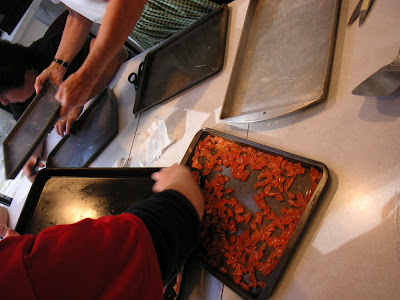 Last weekend was my church's annual Candy Making event for our upcoming Harvest Festival. We gathered in the afternoon in the home of one of our lay folks, and spent the better part of the day making delicious hard candy to sell at the Harvest Festival. This was my second time, and it was heaps of fun. We made a myriad of different flavors, ranging from blueberry cheesecake to peppermint to licorice. About 26 of us came to participate and all ages were represented, from the young kids to those who are still kids at heart. We broke in the evening for a "light" supper (where we all definitely ate our fill...probably so we wouldn't eat the candy), and ended making candy around 8:30 in the evening. It was a true time of fellowship and conversation and work...and enjoying the muted Patriot's game in the background where they trounced the Dallas Cowboys. Good food, good fellowship, and good fun.
Something transformational happens when you get a group of church people out of the church setting. Everyone is more relaxed, has time to engage in deeper conversations with one another - it's like coffee hour squared. Seeing people outside of church somehow puts them in a more natural light. I think from time to time we don't bring our whole selves to church, both the good and the bad, and being together in a different setting helps flesh people out. They become more real, more than just the reflection seen on Sunday morning. Authentic sharing happens because there is more time to talk and be with one another than the quick 5-minute life update during coffee hour or the raising of an answered prayer during joys and concerns. Relationships can truly deepen during these times apart from church because there is the time and the space for fellowship.
I believe I experienced authentic fellowship during our candy making event. And it was truly sweet - and not just because of the candy. ;-) We were all happy to be together, happy to burn our fingers a bit, and happy to help out our church as we made candy to sell at the Harvest Festival. I hope that wherever I end up serving, there will be moments like this in the life of the congregation where true community and fellowship can be experienced.
Friday, October 19, 2007
RevGal Friday Five: Homage to the Top Chef
1. If you were a food, what would you be?
Chicken Noodle Soup. Comforting and familiar, most people like it, and it's good for you. ;-)
2. What is one of the most memorable meals you ever had? And where?
Actually, it was at this French Restaurant in the theater district called Pergola Des Artistes. Affordable, delicious French food. I've eaten there twice now, and each time I wasn't disappointed.
3. What is your favorite comfort food from childhood?
Mac 'n' Cheese...
4. When going to a church potluck, what one recipe from your kitchen is sure to be a hit?
Well, I haven't made many casseroles lately (I love how I automatically equate church potluck with casseroles). But my mom has a macaroni salad recipe that is absolutely delicious! Not too heavy on the mayo or the oil, with delicious veggies and pasta. Mmm!
But I also cook a mean broccoli almond stir fry...
5. What’s the strangest thing you ever willingly ate?
Lobster Ice Cream. Don't try it, it's gross. Why waste the lobster?
Bonus question: What’s your favorite drink to order when looking forward to a great meal?
It honestly depends on the meal (and who's paying ;-)). Generally, I just order water, but occasionally I'm a bad Methodist and go for the wine or a Guinness. That'll have to stop...
Chicken Noodle Soup. Comforting and familiar, most people like it, and it's good for you. ;-)
2. What is one of the most memorable meals you ever had? And where?
Actually, it was at this French Restaurant in the theater district called Pergola Des Artistes. Affordable, delicious French food. I've eaten there twice now, and each time I wasn't disappointed.
3. What is your favorite comfort food from childhood?
Mac 'n' Cheese...
4. When going to a church potluck, what one recipe from your kitchen is sure to be a hit?
Well, I haven't made many casseroles lately (I love how I automatically equate church potluck with casseroles). But my mom has a macaroni salad recipe that is absolutely delicious! Not too heavy on the mayo or the oil, with delicious veggies and pasta. Mmm!
But I also cook a mean broccoli almond stir fry...
5. What’s the strangest thing you ever willingly ate?
Lobster Ice Cream. Don't try it, it's gross. Why waste the lobster?
Bonus question: What’s your favorite drink to order when looking forward to a great meal?
It honestly depends on the meal (and who's paying ;-)). Generally, I just order water, but occasionally I'm a bad Methodist and go for the wine or a Guinness. That'll have to stop...
Thursday, October 18, 2007
"I've Got The Blues..."
I did not really just eat a whole box of Kraft Macaroni and Cheese for dinner.
Except, I just did.
Comfort Food: 1, Melissa: 0.
But I only used half the butter it called for!
Except, I just did.
Comfort Food: 1, Melissa: 0.
But I only used half the butter it called for!
We can't serve both God and Mammon...but we sure do try.
Drew Theological School's Tipple-Vosburgh lectures were this week. Class prevented me from attending most of the workshops and the lectures, however, I did attend one plenary and the closing worship. I really wanted to attend Fred Curtis's (an economics professor at Drew) plenary session on Monday, but it just wasn't viable. It was nice to meet Beth Quick, albeit very briefly! Despite my limited experience of the lectures, for good or for ill, I wanted to offer my reflections:
I'm just not there...and yet, I am there. Perhaps I didn't get the "so what" out of the one plenary because it wasn't geared that way (though I always think we should be asking that question, even in academics), but even the "so what" I heard out of worship didn't push me enough. "Buy clothes from ethical stores and not from WalMart!" "Give out of our excess because we have too much!" Ok...good...but not really very radical. It's not radical to me because we are still participating in this consumer economy that seeks to create our greed, drive our dissatisfaction with the world and our lives, and that still exploits and marginalizes people; we're just putting our money in a different place. It seems to me that while yes - we need things and need to shop to get them - we also need to be subverting the system. Stepping out of that consumer economy all together, if we truly want to be radical.
I think of Shane Claiborne and The Simple Way community in Philadelphia. He made his own habit that he wears every day. The people of the community live together and share their possessions and live in close relationship with the poor around them. To them, poverty has a name and a face...not just a line in the checkbook for donations, or a bag in the hall for stuff to donate.
I struggle with this...a lot. I struggle because I wonder what living like this - in relationship with the poor, living with the basics, sharing our possessions - will look like as there are those of us here at Drew who feel called to a similar lifestyle. So while I'm so far from selling what I have to give to the poor, I do know that there has to be more than just living ethically and responsibly within the system. Ethical and responsible living is a good witness...but doesn't fundamentally change the system. And I'm not sure that Jesus said "live ethically" to the ruler, but told him that he lacked one thing: to go sell his possessions, give the money to the poor, and follow Jesus.
So while this message was something that perhaps some needed to hear, I wanted something more. I wanted to be challenged to seriously consider this radical call to discipleship. I wanted to hear something about being in relationship with the poor, not just being their financial liberators or benefactors. I wanted to hear Jesus.
I'm just not there...and yet, I am there. Perhaps I didn't get the "so what" out of the one plenary because it wasn't geared that way (though I always think we should be asking that question, even in academics), but even the "so what" I heard out of worship didn't push me enough. "Buy clothes from ethical stores and not from WalMart!" "Give out of our excess because we have too much!" Ok...good...but not really very radical. It's not radical to me because we are still participating in this consumer economy that seeks to create our greed, drive our dissatisfaction with the world and our lives, and that still exploits and marginalizes people; we're just putting our money in a different place. It seems to me that while yes - we need things and need to shop to get them - we also need to be subverting the system. Stepping out of that consumer economy all together, if we truly want to be radical.
I think of Shane Claiborne and The Simple Way community in Philadelphia. He made his own habit that he wears every day. The people of the community live together and share their possessions and live in close relationship with the poor around them. To them, poverty has a name and a face...not just a line in the checkbook for donations, or a bag in the hall for stuff to donate.
I struggle with this...a lot. I struggle because I wonder what living like this - in relationship with the poor, living with the basics, sharing our possessions - will look like as there are those of us here at Drew who feel called to a similar lifestyle. So while I'm so far from selling what I have to give to the poor, I do know that there has to be more than just living ethically and responsibly within the system. Ethical and responsible living is a good witness...but doesn't fundamentally change the system. And I'm not sure that Jesus said "live ethically" to the ruler, but told him that he lacked one thing: to go sell his possessions, give the money to the poor, and follow Jesus.
So while this message was something that perhaps some needed to hear, I wanted something more. I wanted to be challenged to seriously consider this radical call to discipleship. I wanted to hear something about being in relationship with the poor, not just being their financial liberators or benefactors. I wanted to hear Jesus.
Friday, October 12, 2007
RevGal Friday Five: The B-I-B-L-E
I haven't played in awhile...but here goes!

Does everyone remember the old Sunday School song?
The B-I-B-L-E,
Oh, that's the book for me.
I take my stand on the Word of God,
The B-I-B-L-E.
Ahh, yes...fond memories...
1. What is your earliest memory of encountering a biblical text?
I remember in jr. church we had to memorize the KJV of Psalm 23. I think I was in 1st or 2nd grade. Earlier than that, I remember having a little book called "My First Bible" and it told snippets of Bible stories for kids with pictures. I still remember the picture of Shadrach, Meshach, and Abednego in the flames, and the picture of Daniel in the Lion's Den with the angel holding the lion's mouth shut. I remember the illustrations more than how the stories were told. Strictly speaking it wasn't dealing with the actual *text* of the Bible, but with the stories...hence, Psalm 23 wins.
2. What is your favorite biblical translation, and why? (You might have a few for different purposes).
Despite my initial skepticism, I'm becoming more fond of Eugene Peterson's paraphrase, The Message. The imagery and the language of the text is powerful and evocative in places. Of course, I don't read it isolated from my trusty NRSV if I'm doing more intensive study or if I'm preaching, although my last sermon borrowed heavily from Peterson's language. Oddly enough, now and again I turn back to the NIV, the first translation I really started reading. I've moved from the NIV to the RSV to the NRSV and then to The Message.
For the Old Testament, however, you just can't beat the Tanakh. We used the Jewish Study Bible for my Old Testament class in seminary, and I'm more prone to read it before the NRSV.
All in all, I like many translations, even some of the more obscure ones. And I also love turning back to the original language (for the New Testament...don't know Hebrew yet) and breaking out my lexicon to attempt my own translation/reading of the text.
3. What is your favorite book of the Bible? Your favorite verse/passage?
Something about Philippians grabs me. Normally, I'm not a huge fan of the Epistles, preferring to read the Gospels...and preferring the Old Testament over the New entirely. But Philippians was one of the first books I did a more in-depth and intentional devotional study on during an Intervarsity retreat during college. Afterwards, a group of us went back to campus and read it aloud at once in the dark with candles and flashlights under a starry sky. Pretty cool.
Instead of listing all of my favorite passages from throughout the Bible (of which there are many), I'll give you my favorite passage from Philippians:
"Do all things without murmuring and arguing, so that you may be blameless and innocent, children of God without blemish in the midst of a crooked and perverse generation, in which you shine like stars in the world. It is by your holding fast to the word of life that I can boast on the day of Christ that I did not run in vain or labor in vain." (Philippians 2:14-16)
I also love the book of Psalms.
4. Which book of the Bible do you consider, in Luther's famous words about James, to be "an epistle of straw?" Which verse(s) make you want to scream?
Aside from the obvious passages about women that Paul may (or may not) have written in 1 Corinthians and 1 Timothy, I have issues with a lot of the Old Testament passages that proclaim material blessing for being faithful to God. I know this is a view that gets challenged over and over again in the OT, but what mostly bothers me about such passages is the way that people use them today. In a similar vein, the "Prayer of Jabez" absolutely drives me up a wall.
5. Inclusive language in biblical translation and liturgical proclamation: for, against, or neutral?
Um, neutral-ish. I recognize the need for it, especially "brothers" to "sisters and brothers", from "mankind" to "humankind", and from "sons of God" to "children of God." However, when it comes to names for God, I'm a bit more picky (though if there were a gender-neutral pronoun for God, I'd be all for it). I really do like Madeleine L'Engle's use of "El" to refer to God. But ultimately, the Bible is a product of a patriarchal society, and to treat it in its context means being faithful to that. Not that I like it very much, of course, but that's the way it is.
Bonus: Back to the Psalms--which one best speaks the prayer of your heart?
There are too many. Psalm 139 fits, along with Psalm 42.

Does everyone remember the old Sunday School song?
The B-I-B-L-E,
Oh, that's the book for me.
I take my stand on the Word of God,
The B-I-B-L-E.
Ahh, yes...fond memories...
1. What is your earliest memory of encountering a biblical text?
I remember in jr. church we had to memorize the KJV of Psalm 23. I think I was in 1st or 2nd grade. Earlier than that, I remember having a little book called "My First Bible" and it told snippets of Bible stories for kids with pictures. I still remember the picture of Shadrach, Meshach, and Abednego in the flames, and the picture of Daniel in the Lion's Den with the angel holding the lion's mouth shut. I remember the illustrations more than how the stories were told. Strictly speaking it wasn't dealing with the actual *text* of the Bible, but with the stories...hence, Psalm 23 wins.
2. What is your favorite biblical translation, and why? (You might have a few for different purposes).
Despite my initial skepticism, I'm becoming more fond of Eugene Peterson's paraphrase, The Message. The imagery and the language of the text is powerful and evocative in places. Of course, I don't read it isolated from my trusty NRSV if I'm doing more intensive study or if I'm preaching, although my last sermon borrowed heavily from Peterson's language. Oddly enough, now and again I turn back to the NIV, the first translation I really started reading. I've moved from the NIV to the RSV to the NRSV and then to The Message.
For the Old Testament, however, you just can't beat the Tanakh. We used the Jewish Study Bible for my Old Testament class in seminary, and I'm more prone to read it before the NRSV.
All in all, I like many translations, even some of the more obscure ones. And I also love turning back to the original language (for the New Testament...don't know Hebrew yet) and breaking out my lexicon to attempt my own translation/reading of the text.
3. What is your favorite book of the Bible? Your favorite verse/passage?
Something about Philippians grabs me. Normally, I'm not a huge fan of the Epistles, preferring to read the Gospels...and preferring the Old Testament over the New entirely. But Philippians was one of the first books I did a more in-depth and intentional devotional study on during an Intervarsity retreat during college. Afterwards, a group of us went back to campus and read it aloud at once in the dark with candles and flashlights under a starry sky. Pretty cool.
Instead of listing all of my favorite passages from throughout the Bible (of which there are many), I'll give you my favorite passage from Philippians:
"Do all things without murmuring and arguing, so that you may be blameless and innocent, children of God without blemish in the midst of a crooked and perverse generation, in which you shine like stars in the world. It is by your holding fast to the word of life that I can boast on the day of Christ that I did not run in vain or labor in vain." (Philippians 2:14-16)
I also love the book of Psalms.
4. Which book of the Bible do you consider, in Luther's famous words about James, to be "an epistle of straw?" Which verse(s) make you want to scream?
Aside from the obvious passages about women that Paul may (or may not) have written in 1 Corinthians and 1 Timothy, I have issues with a lot of the Old Testament passages that proclaim material blessing for being faithful to God. I know this is a view that gets challenged over and over again in the OT, but what mostly bothers me about such passages is the way that people use them today. In a similar vein, the "Prayer of Jabez" absolutely drives me up a wall.
5. Inclusive language in biblical translation and liturgical proclamation: for, against, or neutral?
Um, neutral-ish. I recognize the need for it, especially "brothers" to "sisters and brothers", from "mankind" to "humankind", and from "sons of God" to "children of God." However, when it comes to names for God, I'm a bit more picky (though if there were a gender-neutral pronoun for God, I'd be all for it). I really do like Madeleine L'Engle's use of "El" to refer to God. But ultimately, the Bible is a product of a patriarchal society, and to treat it in its context means being faithful to that. Not that I like it very much, of course, but that's the way it is.
Bonus: Back to the Psalms--which one best speaks the prayer of your heart?
There are too many. Psalm 139 fits, along with Psalm 42.
Thursday, October 11, 2007
First Contact
I read a blog post at the Questing Parson the other day that really made me stop and think for a moment about local churches and how each community perceives itself as a "friendly" church - especially when it comes to visitors. I've been a part of a lot of churches that would label themselves as "welcoming", ranging from those truly hospitable to visitors, to those that are downright suspicious of them, to one that gave out the vibe of "you must conform to belong here" (not United Methodist, incidentally). My sister even told me of a church in her college town that coralled a first-year student into plugging into the church even before this individual had a chance to explore other options ("overly-friendly", perhaps?)
However, with your generic "friendly" church I have to wonder, how deep does that welcome really go? Is it driven largely by the pastor, who has the privilege of getting to know a little about every person who passes through the church doors? Or do laity take the plunge as well, asking details about the life of the newcomer, and taking care to introduce that person or family to others in the congregation (should the individual feel comfortable with it)? Do we give them gift baskets and send them on their way, or do we have them stand up in worship and have them introduce themselves to everyone? And then once people start coming regularly, does anyone take the effort to really get to know "so-and-so who has been coming for three months and is originally from Seattle and has a job in the city"?
Worship is often the first-contact a visitor has with a church, and as such, the reception of the church at its "main meeting" can retain or repel a visitor. I think this is the assumption that most churches have, and the one assumed by the igniting ministry campaign of the UMC. Our task is to be welcoming when people come through the door, no matter their background, appearance, etc..., and yes, that is the case (to a certain extent...should we really be welcoming someone who runs in with a crazed expression and an axe in her hand? Extreme...but I think you get the point).
But I don't think first contact for a visitor should be in worship...or even within the boundaries of the walls of the church. We should be getting to know people even before they step foot in the narthex. We should be out in the community, making contact with people there - through service events, community functions, and the like - learning about their lives and welcoming them then and there. We should be going to where the people are and going deep with them before they even come to worship. Then, once they take the step and come to worship, they will already be known (by at least one or two folks), and what usually is an awkward step for a visitor becomes a more natural transition into the worshiping community.
This is a shift from a church being attractional in its outreach to being more missional and intentional about the ways in which the church and its congregants engage with the community. More thoughts on this to come later...
However, with your generic "friendly" church I have to wonder, how deep does that welcome really go? Is it driven largely by the pastor, who has the privilege of getting to know a little about every person who passes through the church doors? Or do laity take the plunge as well, asking details about the life of the newcomer, and taking care to introduce that person or family to others in the congregation (should the individual feel comfortable with it)? Do we give them gift baskets and send them on their way, or do we have them stand up in worship and have them introduce themselves to everyone? And then once people start coming regularly, does anyone take the effort to really get to know "so-and-so who has been coming for three months and is originally from Seattle and has a job in the city"?
Worship is often the first-contact a visitor has with a church, and as such, the reception of the church at its "main meeting" can retain or repel a visitor. I think this is the assumption that most churches have, and the one assumed by the igniting ministry campaign of the UMC. Our task is to be welcoming when people come through the door, no matter their background, appearance, etc..., and yes, that is the case (to a certain extent...should we really be welcoming someone who runs in with a crazed expression and an axe in her hand? Extreme...but I think you get the point).
But I don't think first contact for a visitor should be in worship...or even within the boundaries of the walls of the church. We should be getting to know people even before they step foot in the narthex. We should be out in the community, making contact with people there - through service events, community functions, and the like - learning about their lives and welcoming them then and there. We should be going to where the people are and going deep with them before they even come to worship. Then, once they take the step and come to worship, they will already be known (by at least one or two folks), and what usually is an awkward step for a visitor becomes a more natural transition into the worshiping community.
This is a shift from a church being attractional in its outreach to being more missional and intentional about the ways in which the church and its congregants engage with the community. More thoughts on this to come later...
Monday, October 08, 2007
A Tribute to Hillie Cass
 As I mentioned in my previous post, life happened this past week. I was supposed to be in Nashville this weekend for the emergingumc gathering when I found out that a long-time member of the church in which I grew up (People's UMC) passed away this past Tuesday. To me, Hillie Cass wasn't just any ordinary member - she and her husband served as adopted grandparents. I don't know if we adopted them first or they adopted us first, but throughout my childhood she would attend our high school concerts and bake us fudge for our birthdays, even after we stopped attending that church. I felt that I should be there for her funeral service. So Ben and I left New Jersey Friday morning, picked up my sister at Williams College, went to the visiting hours, and attended the funeral on Saturday morning before heading back to New Jersey for our respective church services on Sunday.
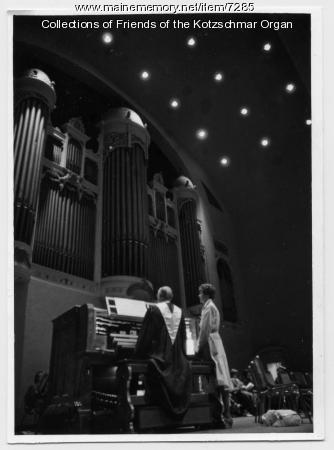
It was she who in large part instilled in me - as she had for many of those who passed through her junior choir - a love of music. We rehearsed and sang during worship every single week. We had to memorize all the music (though if the words were tough she would write them out on a huge piece of paper and hang it on the front pew so we could read the words). I learned how to sing in parts in her choir, and thus I learned to love singing alto. She also sang in the senior choir and I could tell that she loved singing as an act of worship. Her husband Malcolm played the organist at our church - for 67 years! He was the Portland municipal organist for years and years also, and the above picture was him playing the Kotzschmar Organ for the ordination service of the 1987 Maine Annual Conference and behind him is Hillie, turning pages for him as she did for almost every worship service at Peoples that I can remember.
She also had an incredible love for the kids in her junior choir. Every year, she would also throw us a huge ice cream sundae party, where I was introduced to such flavors as chocolate chip cookie dough and to those candied cherries that are a necessary part of any sundae. But this was just how she loved anybody; she had a warm and compassionate spirit that made everyone feel welcome and right at home. She treated everybody as the child of God that person was - no matter who they were.
Hillie enjoyed life, and was always full of joy. She was also very busy! She had so many activities...each one of them about serving other people. Meals on Wheels, Jr. Choir, hosting the bean suppers (to name a few). She just didn't feel right if she wasn't doing something for others. I was so excited to discover at her funeral that Psalm 139 was her favorite Psalm (because it's mine too). As the pastor mentioned in his brief sermon, Hillie definitely lived up to that standard (well, at least the first 18 verses) - she intimately knew her God...and her God knew her inside and out as well.
I'll miss her a lot. I'm very glad that she had a chance to meet Ben; we stopped to see her and her husband on the way back from our honeymoon. I hope that someday, when I'm old (or even just older), I'll be half the kind, caring, loving, generous, full of life woman that she was.
(Obituary here, Featured obituary here)
Thursday, October 04, 2007
What it Means to Preach
I meant to post earlier, but life happened this week (more on that in a post to come).
Preaching. What's the first image that comes to mind when you hear this word? More than likely it is a robed-figure standing in a pulpit, or someone more casually dressed sitting on a stool or walking around on stage...all talking to a gathered assembly of people.
For me, I don't get this image. My first thought is more akin to St. Francis of Assisi's statement: "Preach the gospel at all times, and when necessary, use words." I picture preaching to be more about incarnating God's love to people than it is speaking to a congregation.
So you all can probably imagine my dilemma as we are asked to write our theological context for preaching, predicated on the assumption that preaching is about verbally articulating the faith.
Hmm.
Pulpit preaching is just one small part of how we as Christians preach with our lives. We are always, always preaching - always saying something about the love of God through Jesus Christ in our actions and in the way we treat other people. I really love this line my pastor said in a sermon a few weeks ago: "It’s not when we tell people about Jesus, we’re already doing that. It’s what we’re telling them through our actions."
So in this respect, we are all - clergy and laity alike - preachers of the Word. What gives pastors special authority? You tell me. Is it more scholarly knowledge? A special vocational call? The experience of seminary? Ordination? I don't really know...all I know is that I don't think preaching (when we do it on Sunday mornings) can't just be one person speaking to a group of people.
I think preaching in the context of worship can be ritual, group discussion, art, silence, or a service project. I really love what Tim Lucas of Liquid Church in Morristown did when they canceled weekend services to go serve others. Check it out!
More and more I'm beginning to understand that preaching is more about how we live out the Word of God than anything else. Because if we - both as individuals and as communities of faith - aren't doing God's Word, then what we say from the pulpit is meaningless. Our preaching must come out of a love and a desire to incarnate God's love to a broken and hurting world. And that is what preaching means to me.
Preaching. What's the first image that comes to mind when you hear this word? More than likely it is a robed-figure standing in a pulpit, or someone more casually dressed sitting on a stool or walking around on stage...all talking to a gathered assembly of people.
For me, I don't get this image. My first thought is more akin to St. Francis of Assisi's statement: "Preach the gospel at all times, and when necessary, use words." I picture preaching to be more about incarnating God's love to people than it is speaking to a congregation.
So you all can probably imagine my dilemma as we are asked to write our theological context for preaching, predicated on the assumption that preaching is about verbally articulating the faith.
Hmm.
Pulpit preaching is just one small part of how we as Christians preach with our lives. We are always, always preaching - always saying something about the love of God through Jesus Christ in our actions and in the way we treat other people. I really love this line my pastor said in a sermon a few weeks ago: "It’s not when we tell people about Jesus, we’re already doing that. It’s what we’re telling them through our actions."
So in this respect, we are all - clergy and laity alike - preachers of the Word. What gives pastors special authority? You tell me. Is it more scholarly knowledge? A special vocational call? The experience of seminary? Ordination? I don't really know...all I know is that I don't think preaching (when we do it on Sunday mornings) can't just be one person speaking to a group of people.
I think preaching in the context of worship can be ritual, group discussion, art, silence, or a service project. I really love what Tim Lucas of Liquid Church in Morristown did when they canceled weekend services to go serve others. Check it out!
More and more I'm beginning to understand that preaching is more about how we live out the Word of God than anything else. Because if we - both as individuals and as communities of faith - aren't doing God's Word, then what we say from the pulpit is meaningless. Our preaching must come out of a love and a desire to incarnate God's love to a broken and hurting world. And that is what preaching means to me.
Tuesday, September 25, 2007
The Theological Foundation of Preaching or What is Preaching?
Now that my paper is safely in the hands of my professor, I feel like I can ask this question of you all:
What does it mean to preach? Where to we derive our authority for preaching? What's our theological context for preaching? In essence...what is preaching?
I'm truly interested in hearing what you have to say before I post my own reflections on this. I had to write 5 pages, double-spaced, but I won't hold you to that same standard. ;-)
What does it mean to preach? Where to we derive our authority for preaching? What's our theological context for preaching? In essence...what is preaching?
I'm truly interested in hearing what you have to say before I post my own reflections on this. I had to write 5 pages, double-spaced, but I won't hold you to that same standard. ;-)
Monday, September 24, 2007
Story-Catching
My church planting class recently had dinner with Tim Lucas, who is the lead pastor of liquid church in Morristown, NJ. The church is six years old, and draws about 800 people to three services on Sunday. Their worship is contemporary, and use lots of art and media to communicate their message.
One of the big ways they communicate is through story, particularly through the medium of video. Tim shared with us that he loved to tell stories about people's lives and the transformation that they find in Jesus Christ...or even telling those stories even if they aren't quite there yet. He explained a video that was going to air on Sunday about a couple and the husband's hesitations about coming to church...not just any church, but liquid church in particular. He told us that the video started out just that way, and that that moment was the hook - the crucial moment - of the whole story.
I was thinking that in seminary, at best we are taught to be story-tellers (but only story-tellers through speaking...if we're lucky, we get to be story-tellers through dance and drama. Art lags behind...as does music and film and worship). However, we're not taught to look for stories, to have that mindset, and to "catch" them in the right way. We aren't taught to have that sort of outlook where the story lies in the messiness of things and not the perfect portrait.
Perhaps this is just an issue for me; I don't consider myself to be a story-teller (though I'd love to learn a few techniques).
Anyway, now I'm just procrastinating from doing my classwork. I'll post my reflections on preaching later on...
One of the big ways they communicate is through story, particularly through the medium of video. Tim shared with us that he loved to tell stories about people's lives and the transformation that they find in Jesus Christ...or even telling those stories even if they aren't quite there yet. He explained a video that was going to air on Sunday about a couple and the husband's hesitations about coming to church...not just any church, but liquid church in particular. He told us that the video started out just that way, and that that moment was the hook - the crucial moment - of the whole story.
I was thinking that in seminary, at best we are taught to be story-tellers (but only story-tellers through speaking...if we're lucky, we get to be story-tellers through dance and drama. Art lags behind...as does music and film and worship). However, we're not taught to look for stories, to have that mindset, and to "catch" them in the right way. We aren't taught to have that sort of outlook where the story lies in the messiness of things and not the perfect portrait.
Perhaps this is just an issue for me; I don't consider myself to be a story-teller (though I'd love to learn a few techniques).
Anyway, now I'm just procrastinating from doing my classwork. I'll post my reflections on preaching later on...
Subscribe to:
Posts (Atom)