Nothing ever turns out quite like you expect it to. I expected a smooth morning, even though we didn't have the bulletins ready and I needed one final sermon edit. Ben even took over my Sunday School class this morning so that I could have a little more time to format the bulletin and print it off and copy it.
Silly me, I should have realized that this morning drifted closer to the edge of chaos than I had hoped. But somehow, in the midst of it all, grace happened and everything was OK.
First, I didn't get my computer up and ready for the sermon until halfway through the Prayer of Confession. Ben started the service, and I'm sitting on the floor in my robe (thankfully hidden by the choir), praying that my machine doesn't lock up and that everything loaded properly and there were no extraneous programs open. As I'm doing this, I'm highlighting a second copy of my sermon so that Ben knows when to change slides when I'm speaking.
Next comes...hearing the phone ring. Actually, it rang several times during the service (only one was a relevant call pertaining to the baptism). I'm thinking, "shoot! Why today of all days do we have to leave the doors to the sanctuary open???" Admittedly, I made this decision as a way of being hospitable to late-comers. It certainly wasn't the smartest choice to make today.
We also had to do a little shuffling of the service. I do my best when I'm preaching to preach towards the Table, since Communion immediately follows the sermon. So what do you do when the baptism gets moved unexpectedly in between the two? Go with the flow as best as you can. :-) In the end, it worked out very well and we ended up with, according to many denominations, is the "proper" form of celebrating the Eucharist immediately after baptism. Actually, the United Methodist Hymnal actually suggests moving to Communion afterwards as well.
But the baptism itself went well, and the child I baptized looked so adorable in his white tux - and he didn't even fuss at all when I scooped water on his forehead. He took it all in, observing the congregation as I walked him up and down the aisle, showing him his new aunts and uncles and brothers and sisters and grandmothers and grandfathers in Christ.
Other things were slightly off kilter as well -- like somehow between last week and this week our last Communion rice cake (for non-gluten eaters)...and then once we sent someone to the store to get one, we forget to put it out. So I have to ask the first person in line during Communion to go back and get the rice cake....
And yet...grace happens.
Showing posts with label church. Show all posts
Showing posts with label church. Show all posts
Sunday, November 09, 2008


Sunday, November 02, 2008
All Saints Sunday
One of my favorite "holidays" in the church year is All Saints Day/Sunday. It gives me and everyone a chance to remember the people who have made a difference in our lives; both those who are still alive today and those who have gone before us. Today in worship we emphasized the latter; the congregation has gone through a major grieving period and I felt it was important to acknowledge this and remember the names of all of those people who were special to us who have passed away. We set up a card table with a whole bunch of tealights and after a short meditation, I invited folks to come forward and name a saint and say a word or two about that person. It was truly amazing to see the number of people come forward and - as was later told to me - have the picture on the rotating powerpoint often be that same person being lifted up as the candle was lit.
I know I am surrounded by saints all the time. My cloud of witnesses is big. I shared yesterday some pictures of my grandfather - who was probably the most loving and patient man I have ever met. The picture of him with a bird perched on his finger says it all; being able to hold still long enough and be so peaceful for such a length of time as to allow a bird to feel safe enough to land on his finger is a feat in and of itself! I remember dancing around in the smoke of his pipe, chasing it around and enjoying the smell of it. I remember when I would go shopping with my grandparents; my grandmother and I would be halfway through the store and Papa would still be wandering around, taking time out to look at different things and be curious about them - didn't matter what it was! I remember his messy workbench with wires and half-open electrical contraptions strewn about. I also remember all of his gadgets that he had throughout the house (mostly in the basement, though!) - like a pair of dolphins rotating around in a circle, powered by the induced current a changing magnetic field makes.
Sometimes I feel bad for not having the opportunity to get to know him better. We lived so far away and we only got to see him and Nammie about once a year; twice if we were lucky! But I know he continues to watch me as I grow...and I hope that he can be proud of me! (I'm sure he is, but...yeah. :-) )
I know I am surrounded by saints all the time. My cloud of witnesses is big. I shared yesterday some pictures of my grandfather - who was probably the most loving and patient man I have ever met. The picture of him with a bird perched on his finger says it all; being able to hold still long enough and be so peaceful for such a length of time as to allow a bird to feel safe enough to land on his finger is a feat in and of itself! I remember dancing around in the smoke of his pipe, chasing it around and enjoying the smell of it. I remember when I would go shopping with my grandparents; my grandmother and I would be halfway through the store and Papa would still be wandering around, taking time out to look at different things and be curious about them - didn't matter what it was! I remember his messy workbench with wires and half-open electrical contraptions strewn about. I also remember all of his gadgets that he had throughout the house (mostly in the basement, though!) - like a pair of dolphins rotating around in a circle, powered by the induced current a changing magnetic field makes.
Sometimes I feel bad for not having the opportunity to get to know him better. We lived so far away and we only got to see him and Nammie about once a year; twice if we were lucky! But I know he continues to watch me as I grow...and I hope that he can be proud of me! (I'm sure he is, but...yeah. :-) )
Saturday, October 11, 2008
End of the Week
You know how most people look forward to Fridays? To the end of the work week and to a little bit of R & R on the weekend?
That's how I feel about Mondays, my blessed day of rest. Especially on Saturday nights, especially on those Sundays before I preach. Not that I don't enjoy worship, and leading a congregation. But on Saturday night, Sunday looms large on the horizon. I want my sermon finished, the bulletins done, my things for Sunday gathered neatly by the door (because if I don't do it, I'll forget them), the powerpoint finished with the perfect images...and the list goes on.
It's on Saturday nights that I'm struck by the incredible amount of energy that goes into the Sunday morning "event." It's the culmination of the pastor's work week; everything that has gone before has led up to getting ready for that one hour (or hour-and-a-half) on Sunday. Half of our "half-time" status at this church goes into thinking about and planning for worship. And it's on nights like these when I wonder if is really how things should be.
Why is it that the bulk of our time goes into preparing worship and not going out into the community, meeting people, making disciples, forming leaders, equipping the laity? How come so much of what we do is performance based rather than relational? Sunday morning worship rarely facilitates relationship - with God for some, with other people not at all.
But for now, it's about the Sundays and the Saturday nights and looking forward to the Mondays.
That's how I feel about Mondays, my blessed day of rest. Especially on Saturday nights, especially on those Sundays before I preach. Not that I don't enjoy worship, and leading a congregation. But on Saturday night, Sunday looms large on the horizon. I want my sermon finished, the bulletins done, my things for Sunday gathered neatly by the door (because if I don't do it, I'll forget them), the powerpoint finished with the perfect images...and the list goes on.
It's on Saturday nights that I'm struck by the incredible amount of energy that goes into the Sunday morning "event." It's the culmination of the pastor's work week; everything that has gone before has led up to getting ready for that one hour (or hour-and-a-half) on Sunday. Half of our "half-time" status at this church goes into thinking about and planning for worship. And it's on nights like these when I wonder if is really how things should be.
Why is it that the bulk of our time goes into preparing worship and not going out into the community, meeting people, making disciples, forming leaders, equipping the laity? How come so much of what we do is performance based rather than relational? Sunday morning worship rarely facilitates relationship - with God for some, with other people not at all.
But for now, it's about the Sundays and the Saturday nights and looking forward to the Mondays.
Tuesday, September 30, 2008
The Value of a Nickel
 The church I serve is across the street from the city's poorest and most dangerous sections; the small part, as the previous pastor told us, gives the city it's bad reputation. Because of our location, we get phone calls once in awhile about people asking for help with groceries or with food. I have to guess that we get more calls then actually make it through to us; since we're not in the office on a consistent basis, I'm sure there are people who call and who don't leave a message. We do maintain a small food pantry that the church goes through every once in awhile to make sure the cans haven't expired, and there are a few folks who donate food to us to keep it stocked. While certainly not put to its best use, it serves a function in the community and there are people who need a bag or two of groceries to tie themselves over until their next pay check comes in who are able to find what they need.
One of my first experiences helping someone out came a few weeks ago. A woman called the church after our Sunday worship service and explained that she needed a gallon of milk for her kids, and explained the circumstances surrounding that need. I told her to come on down to the church and I'd be there with milk for her and her family. I dashed down the street to the Walgreens to get some in time for her arrival. By this time, most of the church folk had left except for my husband and I and some others who were cleaning up after coffee fellowship.
Several minutes later, she arrived bringing her daughter with her and I gave her the milk and showed her back to our small food pantry in case there was anything else she needed. This girl - probably about six or seven - was the most extroverted, loving, joyous, and friendly little girl I have ever seen. Everything in the church she approached with an inquisitive spirit -- "let's see this!" or "can I play with this?" or spontaneously giving hugs to those she saw. I have to say that I was quite enchanted by her spirit of love and acceptance to everyone and her exuberance for life.
While I was showing her around and sharing toys with her, she impulsively decided to share something with me. She was showing off her purse and I was admiring it and wanted to show me what was inside. She pulled out three quarters and one nickel. I admired how much money she had, and she smiled up at me and took a quarter and put it into my hand. "This is for you!" she exclaimed. I was taken aback and a more than a little unsure as to how to respond. After all, this kid I had barely met, whose family was facing difficult economic times, had just given me a significant amount of the money she had to her name. I shook my head and told her she should keep it, but she wouldn't hear of it. Finally, she allowed me to exchange the quarter she had given me for her nickel.
I continue to ponder this unusual exchange. Part of me feels like I should have kept the quarter she had so generously given - like the woman who places all she has into the Temple treasury in Mark 12:38-44, this girl had freely given away her money without question -- in this case to a complete stranger! A quarter, to this little girl, is a lot of money, but she still wanted to give it away to share what she had with me.
The nickel I kept currently sits on my dresser as a reminder of this exchange. It reminds me that even when we have little, we are called to give. It reminds me that a tithe is only a starting place and that we are called to go above and beyond to be good stewards of the resources that God has given us. It reminds me that all that we have and all that we are are to be used at God's disposal. It reminds me that even in these tough economic times, it's no excuse to cut God out of the equation.
I believe that this girl gave me more than just a nickel that day; she taught me a powerful lesson on what it means to give no matter where we are in life, no matter what our circumstances, and no matter how much we think we have that's of worth.
Several minutes later, she arrived bringing her daughter with her and I gave her the milk and showed her back to our small food pantry in case there was anything else she needed. This girl - probably about six or seven - was the most extroverted, loving, joyous, and friendly little girl I have ever seen. Everything in the church she approached with an inquisitive spirit -- "let's see this!" or "can I play with this?" or spontaneously giving hugs to those she saw. I have to say that I was quite enchanted by her spirit of love and acceptance to everyone and her exuberance for life.
While I was showing her around and sharing toys with her, she impulsively decided to share something with me. She was showing off her purse and I was admiring it and wanted to show me what was inside. She pulled out three quarters and one nickel. I admired how much money she had, and she smiled up at me and took a quarter and put it into my hand. "This is for you!" she exclaimed. I was taken aback and a more than a little unsure as to how to respond. After all, this kid I had barely met, whose family was facing difficult economic times, had just given me a significant amount of the money she had to her name. I shook my head and told her she should keep it, but she wouldn't hear of it. Finally, she allowed me to exchange the quarter she had given me for her nickel.
I continue to ponder this unusual exchange. Part of me feels like I should have kept the quarter she had so generously given - like the woman who places all she has into the Temple treasury in Mark 12:38-44, this girl had freely given away her money without question -- in this case to a complete stranger! A quarter, to this little girl, is a lot of money, but she still wanted to give it away to share what she had with me.
The nickel I kept currently sits on my dresser as a reminder of this exchange. It reminds me that even when we have little, we are called to give. It reminds me that a tithe is only a starting place and that we are called to go above and beyond to be good stewards of the resources that God has given us. It reminds me that all that we have and all that we are are to be used at God's disposal. It reminds me that even in these tough economic times, it's no excuse to cut God out of the equation.
I believe that this girl gave me more than just a nickel that day; she taught me a powerful lesson on what it means to give no matter where we are in life, no matter what our circumstances, and no matter how much we think we have that's of worth.
(image from http://http://www.coinfacts.com/nickels/jefferson_nickels/1971_No_S_Jefferson_Nickel_Obverse.jpg)
Monday, October 22, 2007
Sweet Fellowship
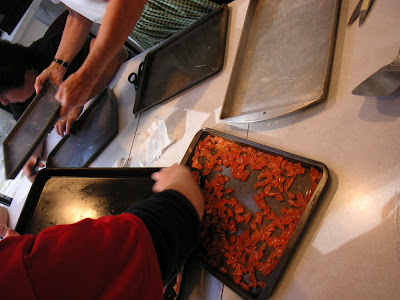 Last weekend was my church's annual Candy Making event for our upcoming Harvest Festival. We gathered in the afternoon in the home of one of our lay folks, and spent the better part of the day making delicious hard candy to sell at the Harvest Festival. This was my second time, and it was heaps of fun. We made a myriad of different flavors, ranging from blueberry cheesecake to peppermint to licorice. About 26 of us came to participate and all ages were represented, from the young kids to those who are still kids at heart. We broke in the evening for a "light" supper (where we all definitely ate our fill...probably so we wouldn't eat the candy), and ended making candy around 8:30 in the evening. It was a true time of fellowship and conversation and work...and enjoying the muted Patriot's game in the background where they trounced the Dallas Cowboys. Good food, good fellowship, and good fun.
Something transformational happens when you get a group of church people out of the church setting. Everyone is more relaxed, has time to engage in deeper conversations with one another - it's like coffee hour squared. Seeing people outside of church somehow puts them in a more natural light. I think from time to time we don't bring our whole selves to church, both the good and the bad, and being together in a different setting helps flesh people out. They become more real, more than just the reflection seen on Sunday morning. Authentic sharing happens because there is more time to talk and be with one another than the quick 5-minute life update during coffee hour or the raising of an answered prayer during joys and concerns. Relationships can truly deepen during these times apart from church because there is the time and the space for fellowship.
I believe I experienced authentic fellowship during our candy making event. And it was truly sweet - and not just because of the candy. ;-) We were all happy to be together, happy to burn our fingers a bit, and happy to help out our church as we made candy to sell at the Harvest Festival. I hope that wherever I end up serving, there will be moments like this in the life of the congregation where true community and fellowship can be experienced.
Thursday, October 11, 2007
First Contact
I read a blog post at the Questing Parson the other day that really made me stop and think for a moment about local churches and how each community perceives itself as a "friendly" church - especially when it comes to visitors. I've been a part of a lot of churches that would label themselves as "welcoming", ranging from those truly hospitable to visitors, to those that are downright suspicious of them, to one that gave out the vibe of "you must conform to belong here" (not United Methodist, incidentally). My sister even told me of a church in her college town that coralled a first-year student into plugging into the church even before this individual had a chance to explore other options ("overly-friendly", perhaps?)
However, with your generic "friendly" church I have to wonder, how deep does that welcome really go? Is it driven largely by the pastor, who has the privilege of getting to know a little about every person who passes through the church doors? Or do laity take the plunge as well, asking details about the life of the newcomer, and taking care to introduce that person or family to others in the congregation (should the individual feel comfortable with it)? Do we give them gift baskets and send them on their way, or do we have them stand up in worship and have them introduce themselves to everyone? And then once people start coming regularly, does anyone take the effort to really get to know "so-and-so who has been coming for three months and is originally from Seattle and has a job in the city"?
Worship is often the first-contact a visitor has with a church, and as such, the reception of the church at its "main meeting" can retain or repel a visitor. I think this is the assumption that most churches have, and the one assumed by the igniting ministry campaign of the UMC. Our task is to be welcoming when people come through the door, no matter their background, appearance, etc..., and yes, that is the case (to a certain extent...should we really be welcoming someone who runs in with a crazed expression and an axe in her hand? Extreme...but I think you get the point).
But I don't think first contact for a visitor should be in worship...or even within the boundaries of the walls of the church. We should be getting to know people even before they step foot in the narthex. We should be out in the community, making contact with people there - through service events, community functions, and the like - learning about their lives and welcoming them then and there. We should be going to where the people are and going deep with them before they even come to worship. Then, once they take the step and come to worship, they will already be known (by at least one or two folks), and what usually is an awkward step for a visitor becomes a more natural transition into the worshiping community.
This is a shift from a church being attractional in its outreach to being more missional and intentional about the ways in which the church and its congregants engage with the community. More thoughts on this to come later...
However, with your generic "friendly" church I have to wonder, how deep does that welcome really go? Is it driven largely by the pastor, who has the privilege of getting to know a little about every person who passes through the church doors? Or do laity take the plunge as well, asking details about the life of the newcomer, and taking care to introduce that person or family to others in the congregation (should the individual feel comfortable with it)? Do we give them gift baskets and send them on their way, or do we have them stand up in worship and have them introduce themselves to everyone? And then once people start coming regularly, does anyone take the effort to really get to know "so-and-so who has been coming for three months and is originally from Seattle and has a job in the city"?
Worship is often the first-contact a visitor has with a church, and as such, the reception of the church at its "main meeting" can retain or repel a visitor. I think this is the assumption that most churches have, and the one assumed by the igniting ministry campaign of the UMC. Our task is to be welcoming when people come through the door, no matter their background, appearance, etc..., and yes, that is the case (to a certain extent...should we really be welcoming someone who runs in with a crazed expression and an axe in her hand? Extreme...but I think you get the point).
But I don't think first contact for a visitor should be in worship...or even within the boundaries of the walls of the church. We should be getting to know people even before they step foot in the narthex. We should be out in the community, making contact with people there - through service events, community functions, and the like - learning about their lives and welcoming them then and there. We should be going to where the people are and going deep with them before they even come to worship. Then, once they take the step and come to worship, they will already be known (by at least one or two folks), and what usually is an awkward step for a visitor becomes a more natural transition into the worshiping community.
This is a shift from a church being attractional in its outreach to being more missional and intentional about the ways in which the church and its congregants engage with the community. More thoughts on this to come later...
Monday, September 24, 2007
Story-Catching
My church planting class recently had dinner with Tim Lucas, who is the lead pastor of liquid church in Morristown, NJ. The church is six years old, and draws about 800 people to three services on Sunday. Their worship is contemporary, and use lots of art and media to communicate their message.
One of the big ways they communicate is through story, particularly through the medium of video. Tim shared with us that he loved to tell stories about people's lives and the transformation that they find in Jesus Christ...or even telling those stories even if they aren't quite there yet. He explained a video that was going to air on Sunday about a couple and the husband's hesitations about coming to church...not just any church, but liquid church in particular. He told us that the video started out just that way, and that that moment was the hook - the crucial moment - of the whole story.
I was thinking that in seminary, at best we are taught to be story-tellers (but only story-tellers through speaking...if we're lucky, we get to be story-tellers through dance and drama. Art lags behind...as does music and film and worship). However, we're not taught to look for stories, to have that mindset, and to "catch" them in the right way. We aren't taught to have that sort of outlook where the story lies in the messiness of things and not the perfect portrait.
Perhaps this is just an issue for me; I don't consider myself to be a story-teller (though I'd love to learn a few techniques).
Anyway, now I'm just procrastinating from doing my classwork. I'll post my reflections on preaching later on...
One of the big ways they communicate is through story, particularly through the medium of video. Tim shared with us that he loved to tell stories about people's lives and the transformation that they find in Jesus Christ...or even telling those stories even if they aren't quite there yet. He explained a video that was going to air on Sunday about a couple and the husband's hesitations about coming to church...not just any church, but liquid church in particular. He told us that the video started out just that way, and that that moment was the hook - the crucial moment - of the whole story.
I was thinking that in seminary, at best we are taught to be story-tellers (but only story-tellers through speaking...if we're lucky, we get to be story-tellers through dance and drama. Art lags behind...as does music and film and worship). However, we're not taught to look for stories, to have that mindset, and to "catch" them in the right way. We aren't taught to have that sort of outlook where the story lies in the messiness of things and not the perfect portrait.
Perhaps this is just an issue for me; I don't consider myself to be a story-teller (though I'd love to learn a few techniques).
Anyway, now I'm just procrastinating from doing my classwork. I'll post my reflections on preaching later on...
Sunday, June 10, 2007
Too liberal for the conservatives, and too conservative for the liberals
There are lots of ideological stances that divide us, particularly when it comes to theology - whether or not one believes that Christ is the only way to God, whether or not one believes that the Bible is the inerrant Word of God, whether or not one believes x, y, z....you get the idea.
I've always been fascinated by the fact that in our conference, one's perspective on the homosexuality "issue" automatically lands you in one of two camps: the "liberal" camp or the "conservative" one. I think you can figure out which is which. Rarely (with few exceptions) does anything else factor into this strange sorting process. (Interestingly enough, the Institute of Religion and Democracy paints with a similar brush...if I can find the article, I'll post it here).
Part of the problem here is the labeling of people into categories based on individuals believing "this" vs. "that". Such a dualistic way of thinking I find to be inherently dangerous (as it grants humans too much power to decide who is "in" and "out"). But another part of the problem here is that...some people just don't fit.
I, for one, don't. It's not just that I'm not liberal or conservative, or that I have some "conservative beliefs" and some "liberal" ones all mixed together. I'm not even sure I'm in the middle, really. It's more that these categories don't make sense at all when applied to me, or to some others that I know. I feel as if I'm outside of the current system all together.
When it comes right down to it, though, why can't we all just call each other brothers and sisters in Christ? Why can't we all see each other as God's children - just the same as everyone else? If we have to go around defining people, why can't this definition trump them all? In the end, "liberal" and "conservative" - or even "moderate" won't make an ounce of difference. How faithfully we lived out the gospel message, however, will. And really, isn't that all that matters?
I've always been fascinated by the fact that in our conference, one's perspective on the homosexuality "issue" automatically lands you in one of two camps: the "liberal" camp or the "conservative" one. I think you can figure out which is which. Rarely (with few exceptions) does anything else factor into this strange sorting process. (Interestingly enough, the Institute of Religion and Democracy paints with a similar brush...if I can find the article, I'll post it here).
Part of the problem here is the labeling of people into categories based on individuals believing "this" vs. "that". Such a dualistic way of thinking I find to be inherently dangerous (as it grants humans too much power to decide who is "in" and "out"). But another part of the problem here is that...some people just don't fit.
I, for one, don't. It's not just that I'm not liberal or conservative, or that I have some "conservative beliefs" and some "liberal" ones all mixed together. I'm not even sure I'm in the middle, really. It's more that these categories don't make sense at all when applied to me, or to some others that I know. I feel as if I'm outside of the current system all together.
When it comes right down to it, though, why can't we all just call each other brothers and sisters in Christ? Why can't we all see each other as God's children - just the same as everyone else? If we have to go around defining people, why can't this definition trump them all? In the end, "liberal" and "conservative" - or even "moderate" won't make an ounce of difference. How faithfully we lived out the gospel message, however, will. And really, isn't that all that matters?
Saturday, March 03, 2007
Turn Up the Heat!
"There was a time when the church was very powerful in the time when the early Christians rejoiced at being deemed worthy to suffer for what they believed. The church was not merely a thermometer that recorded the ideas and principles of popular opinion; it was a thermostat that transformed the mores of society."
- Martin Luther King Jr., Letter from Birmingham Jail, April 1963
I've been thinking a lot about this quote lately. I can't seem to get it out of my head. Ben mentioned it to me in some context (which I have long since forgotten, though it was only a couple days ago), and it re-emerged again in the OSL morning prayer rite during the readings for reflection portion (Ben had picked that passage). It really strikes me that in the 40+ years since Martin Luther King Jr. wrote these words on scraps of paper and newsprint, nothing has changed. The Church is still reactionary, responding to the culture as opposed to putting pressure on it to change.
Change is only achieved by the application of pressure to a system. Examining this from a physics perspective, if you want to move an object, you have to supply an external force to the system. If you want to change the direction of an already moving object? Apply force in a different direction. You want the temperature to rise? You have to put the pressure on.
In contrast, the Church acts by reaction. The object moves along, and all the Church says is "this object is moving at 'x' miles per hour." The Church may claim that the speed is "too fast" or "too slow" or that the object shouldn't even be moving at all! But, it is a response to what is already happening in society. It doesn't challenge popular opinion; it merely accepts it, and moves along. Or, it passes a resolution that gets buried in a book, and nothing happens.
I wonder if this is because the Church is largely comprised of thermometer Christians. Christians who check themselves against the tides of the mainstream, say "yea" or "nay" and subsequently go about business as scheduled. They may get angry about what they find, but how likely is the average person sitting in the pew on Sunday morning to take that anger and channel it to challenge the system, to initiate change, to put the pressure on? We need more thermostat Christians in our midst to "turn up the heat" and transform the mores of our culture.
- Martin Luther King Jr., Letter from Birmingham Jail, April 1963
I've been thinking a lot about this quote lately. I can't seem to get it out of my head. Ben mentioned it to me in some context (which I have long since forgotten, though it was only a couple days ago), and it re-emerged again in the OSL morning prayer rite during the readings for reflection portion (Ben had picked that passage). It really strikes me that in the 40+ years since Martin Luther King Jr. wrote these words on scraps of paper and newsprint, nothing has changed. The Church is still reactionary, responding to the culture as opposed to putting pressure on it to change.
Change is only achieved by the application of pressure to a system. Examining this from a physics perspective, if you want to move an object, you have to supply an external force to the system. If you want to change the direction of an already moving object? Apply force in a different direction. You want the temperature to rise? You have to put the pressure on.
In contrast, the Church acts by reaction. The object moves along, and all the Church says is "this object is moving at 'x' miles per hour." The Church may claim that the speed is "too fast" or "too slow" or that the object shouldn't even be moving at all! But, it is a response to what is already happening in society. It doesn't challenge popular opinion; it merely accepts it, and moves along. Or, it passes a resolution that gets buried in a book, and nothing happens.
I wonder if this is because the Church is largely comprised of thermometer Christians. Christians who check themselves against the tides of the mainstream, say "yea" or "nay" and subsequently go about business as scheduled. They may get angry about what they find, but how likely is the average person sitting in the pew on Sunday morning to take that anger and channel it to challenge the system, to initiate change, to put the pressure on? We need more thermostat Christians in our midst to "turn up the heat" and transform the mores of our culture.
Wednesday, February 21, 2007
Megachurches and multicultural worship
Last link, I swear....it's about how megachurches are "desegregating" worship.
Monday, January 29, 2007
Two Challenging Posts
I apologize for not keeping up with posting; Drew Telecom has not yet made internet service available in my bedroom, and so right now I’m sharing the connection with two other lovely people. I’m sorry to say that this whole moving experience has not been entirely a positive one. Rather than meaninglessly rip on Drew’s sub-par administrative network, my hope is to express my concerns in a constructive light by means of a letter (sent to Facilities, Residence Life, Housing, the Deans of the Theological School, and the Provost). I’m not the only one who has had a…difficult experience with the first three departments (or more to the point, the first two).
Anyway, the last half of that above paragraph is not the intention of my post. Because the past couple days have eluded me in terms of subjects to write blog posts about, I submit for your consideration two blog posts by others that have sparked me to think.
The first is actually a series of two posts from D. S. Mike, who is a D.S. up in New England. He gives us a challenge: why are you a Christian in 100 words or less (using no religious jargon!)
The second is from Steeple Soapbox, who is none other than my adorable and loving fiancé. He wrote a post called "Why Doesn't the Church Ever Change?"
Anyway, the last half of that above paragraph is not the intention of my post. Because the past couple days have eluded me in terms of subjects to write blog posts about, I submit for your consideration two blog posts by others that have sparked me to think.
The first is actually a series of two posts from D. S. Mike, who is a D.S. up in New England. He gives us a challenge: why are you a Christian in 100 words or less (using no religious jargon!)
The second is from Steeple Soapbox, who is none other than my adorable and loving fiancé. He wrote a post called "Why Doesn't the Church Ever Change?"
Subscribe to:
Posts (Atom)